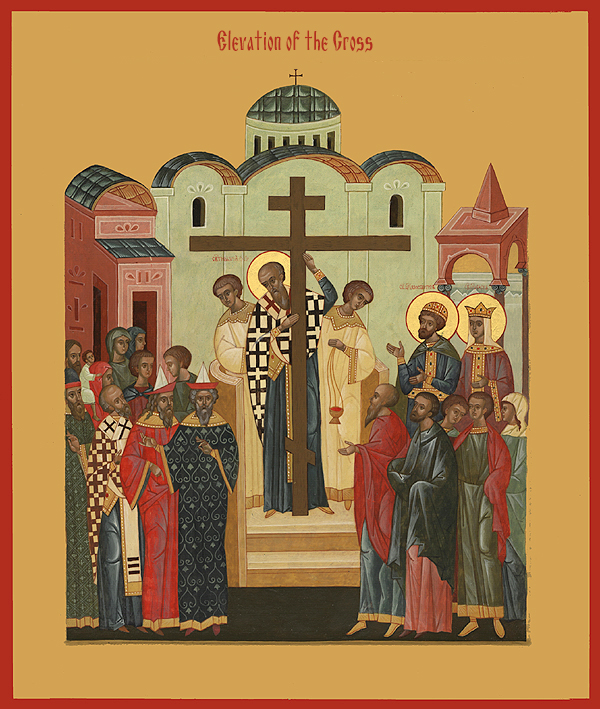

12th SUNDAY AFTER PENTECOST
LITURGY:
Epistle: 1 Corinthians 15:1-11
Gospel: Matthew 19:16-26
***
1 Corinthians 15:1-11 (Epistle)
Moreover, brethren, I declare to you the gospel which I preached to you, which also you received and in which you stand, by which also you are saved, if you hold fast that word which I preached to you – unless you believed in vain. For I delivered to you first of all that which I also received: that Christ died for our sins according to the Scriptures, and that He was buried, and that He rose again the third day according to the Scriptures, and that He was seen by Cephas, then by the twelve. After that He was seen by over five hundred brethren at once, of whom the greater part remain to the present, but some have fallen asleep. After that He was seen by James, then by all the apostles. Then last of all He was seen by me also, as by one born out of due time. For I am the least of the apostles, who am not worthy to be called an apostle, because I persecuted the church of God. But by the grace of God I am what I am, and His grace toward me was not in vain; but I labored more abundantly than they all, yet not I, but the grace of God which was with me. Therefore, whether it was I or they, so we preach and so you believed.
Matthew 19:16-26 (Gospel)
Now behold, one came and said to Him, “Good Teacher, what good thing shall I do that I may have eternal life?” So He said to him, “Why do you call Me good? No one is good but One, that is, God. But if you want to enter into life, keep the commandments.” He said to Him, “Which ones?” Jesus said, “’You shall not murder,’ ‘You shall not commit adultery,’ ‘You shall not steal,’ ‘You shall not bear false witness,’ ’Honor your father and your mother,’ and, ‘You shall love your neighbor as yourself.’ “ The young man said to Him, “All these things I have kept from my youth. What do I still lack?” Jesus said to him, “If you want to be perfect, go, sell what you have and give to the poor, and you will have treasure in heaven; and come, follow Me.” But when the young man heard that saying, he went away sorrowful, for he had great possessions. Then Jesus said to His disciples, “Assuredly, I say to you that it is hard for a rich man to enter the kingdom of heaven. And again I say to you, it is easier for a camel to go through the eye of a needle than for a rich man to enter the kingdom of God. When His disciples heard it, they were greatly astonished, saying, “Who then can be saved?” But Jesus looked at them and said to them, “With men this is impossible, but with God all things are possible.”
***
Homily on the 12th Sunday after Pentecost (15 September 2024)
Fr. Peter Choi
In the name of the Father, Son, and Holy Spirit. Amen. Glory be to Jesus Christ!
Today’s reading from the Gospel according to St. Matthew (19.16-26) is about Jesus and the rich young man. This is the story of a devout young man who wants to know what he must do to have eternal life but is unable to do this when he hears the answer. And we can compare this story to the history of the apostle Paul. The difference between the two is in their willingness to let go.
Let‘s start with the rich young man first. We don’t have a lot of information about him but we can infer that he was probably not from the religious ruling class, the priests and scribes who were Sadducees, because he was interested in eternal life, which the Sadducees did not believe in. There’s nothing to suggest that he was looking for a political answer so he probably wasn’t a Zealot. He seemed to be scrupulous in following the Mosaic law, the Torah, so he was probably a Pharisee if we had to put him into one of the categories of first-century Jews.
If he lived in today’s society, we would probably like him. He would be the nice young man who is morally upright, desires to do good, and happens to be rich with many possessions and property. As well, the rich young man was earnest – he truly wanted eternal life. In the version of this story in the Gospel according to St. Mark (10.17-27), Mark noted that Jesus looked at the man and loved him. And Jesus said to the rich young man, “If you want to be perfect, go, sell what you have and give to the poor; and you will have treasure in heaven; and come, follow Me.” (Mt 19.21) What was Jesus saying in that sentence?
Jesus was telling the young man that His answer was dependent on whether the man wanted to become what he was intended to be. The Greek word translated as “perfect” is teleios, which comes from the word telos – the end or intended goal. Something is perfected when it does what it is created to do. For example, the telos for a pair of scissors is to cut. What Jesus told the rich young man was that the telos of someone who wants to live forever is to give up their possessions and follow Jesus. Also notice that Jesus didn’t call the money that would be received from selling the rich man’s possessions “your money.” And when Jesus talked about giving up possessions, He wasn’t just talking about the things that the man owned. The possessions that the young man was unable to give up were the properties he owned – that’s what the word “possession” (in Mt 19.22) refers to. The young man was unwilling to be landless, to no longer have a home in this world. He could not make the choice to abandon the security of his earthly home for a relationship with Jesus.
In contrast to the rich young man, St. Paul’s story ends differently. To a certain extent, Paul has similarities to the rich young man. Before his conversion, Paul was Saul. He was a young man. He was a Pharisee who wanted to do what was good so he could have eternal life. In fact, he was so zealous that he actively persecuted, to the point of death, any Jew who blasphemed God or contradicted the teachings of Moses and the prophets. If he lived in today’s society, I’m not sure we would have liked Saul. We would probably have called him a militant fundamentalist.
The difference between Saul and the rich young man was in their ability to let go. Saul didn’t have the possessions of the rich young man but he had his zeal, his reputation, and his knowledge of God. In the Acts of the Apostles we are told that he encountered Jesus and was blinded on the road to Damascus. He was instructed to go to Damascus and to be told what to do. And when his sight was restored by Ananias, what did he do? He was baptized. He let go of his previous understanding of Jesus as a false prophet. He let go of his previous zeal against Christians. Instead, he let go of his reputation as a devout Pharisee to become a follower of Jesus the Messiah.
Letting go of our possessions, our reputations, and whatever else we value is needed to follow Jesus. We are asked to place our trust in Jesus Christ. This is not easy: “it is easier for a camel to go through the eye of a needle than for someone who is rich to enter the kingdom of God.” (Mt 19.24) When we look at our material wealth, our social standing, and our skills and talents as belonging to ourselves, we are like the rich young man. We’re not able to follow Jesus when we rely on these things. When we let go of them, when we empty ourselves of them, we are then able to follow Jesus because we can now be filled with the grace of the Holy Spirit.
This is what enabled Saul to become the apostle Paul: “But by the grace of God I am what I am, and His grace toward me was not in vain; but I labored more abundantly than they all, yet not I, but the grace of God which was with me.” (1 Cor 15.10). This is what differentiated Paul from the rich young man.
As followers of Jesus Christ, we are constantly asked to let go of the things that are of this present age. Very rarely are we asked in the dramatic fashion experienced by the rich young man or by Paul. But we are asked whenever we have to choose between relying on ourselves or relying on the Holy Spirit. If we have to choose, do we enrich ourselves or give alms? Do we identify ourselves as Christians through our words and actions in situations that may be hostile to our faith? Are we able to let go of our schedule when someone in need asks for our time?As citizens of this present age, our answers would be “no.” But as citizens of the age to come, if we permit the love of Jesus Christ and the grace of the Holy Spirit to fill us, then our answers will be “yes.” Let us continue to pray and strive to achieve our telos, our perfection, by His love and grace so that we may enter into the kingdom of the Father, Son, and Holy Spirit. Amen.
 Holy Theophany Mission