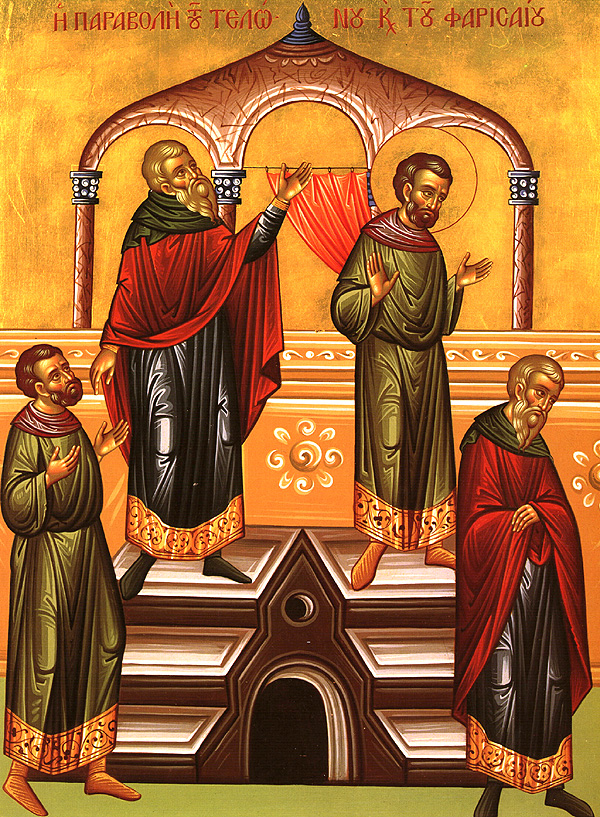

SUNDAY OF THE PUBLICAN AND THE PHARISEE
LITURGY:
Epistle: 2 Timothy 3:10-15
Gospel: Luke 18:10-14
Beginning of the Lenten Triodion – Feb 9, 2025
“for everyone who exalts himself will be humbled, and he who humbles himself will be exalted.”
***
2 Timothy 3:10-15 (Epistle)
But you have carefully followed my doctrine, manner of life, purpose, faith, longsuffering, love, perseverance, persecutions, afflictions, which happened to me at Antioch, at Iconium, at Lystra – what persecutions I endured. And out of them all the Lord delivered me. Yes, and all who desire to live godly in Christ Jesus will suffer persecution. But evil men and impostors will grow worse and worse, deceiving and being deceived. But you must continue in the things which you have learned and been assured of, knowing from whom you have learned them, and that from childhood you have known the Holy Scriptures, which are able to make you wise for salvation through faith which is in Christ Jesus.
Luke 18:10-14 (Gospel)
“Two men went up to the temple to pray, one a Pharisee and the other a tax collector. The Pharisee stood and prayed thus with himself, ‘God, I thank You that I am not like other men – extortioners, unjust, adulterers, or even as this tax collector. I fast twice a week; I give tithes of all that I possess.’ And the tax collector, standing afar off, would not so much as raise his eyes to heaven, but beat his breast, saying, ‘God, be merciful to me a sinner!’ I tell you, this man went down to his house justified rather than the other; for everyone who exalts himself will be humbled, and he who humbles himself will be exalted.”
***
Homily for the Sunday of the Publican and the Pharisee (9 February 2025)
Fr. Peter Choi
In the name of the Father, Son, and Holy Spirit. Amen. Christ is in our midst!
Today is the Sunday of the Publican and the Pharisee and on this day, we begin using the service book for Great Lent, the Lenten Triodion. There will be three more Sundays before we enter into the season of Great Lent, our preparation for the Resurrection of our Lord and God and Saviour Jesus Christ. So the Church prepares us for this season by prescribing a series of readings. The messages from these readings are like the warm-up exercises before we start our physical and ascetic exertions.
Last Sunday was Zacchaeus Sunday and in the Gospel reading, we saw the desire of Zacchaeus to see Jesus and to live up to his name, Zacchaeus, which comes from the Hebrew verb for “pure” or “clean.” We saw how Zacchaeus’s desire spurred him to act. That is the first step. For those who are desire to see God and find Truth, this desire can only be realized by acting, for example, by going to church or asking those who know God. And with this desire and the decision to act, we arrive at today’s parable in the Gospel according to St. Luke (18.10-14).
Luke prefaces this parable with the following statement, which wasn’t read out in today’s reading: “He (Jesus) also told this parable to some who trusted in themselves that they were righteous and regarded others with contempt” (Lk 18.9). This parable is about two believers, Jews, who are praying in the Temple. And I want to reflect on some of the characteristics of these two persons and their prayers and our reactions to them. The point is that a right relationship with God (righteousness) requires us to act in a manner pleasing to God (good works) while acknowledging that our ability to be in communion with God is because of His grace (His bestowal of favour upon us). And in the same manner in which God bestows His grace upon us, so too are we to bestow our favour upon others.
I’ve often said that the parables of Jesus often have three parties: God and two other individuals. And we often have a tendency to identify with one of the two characters and judge the other. Just ask yourself, in this parable, do you find yourself doing this? So let’s look at the two men in this parable.
Let’s first reflect upon the Pharisee. In the time of Jesus, Judaism wasn’t a homogeneous religion. In fact, it was a lot like the state of Christianity nowadays in terms of the political and theological differences between different Christian traditions. The Pharisees was one of the various groups who called themselves Jews and worshiped the God of Israel. In terms of their beliefs and behaviours, they would have been the equivalent to Orthodox Christians in Christianity today. They believed that the coming of the Messiah required Jews to be righteous and righteousness required Jews to follow the Torah, the law of God, which had been given to their forefather Moses. And to help them understand the Torah, they had teachers, rabbis, who would interpret the Scriptures. The Pharisees were the Jews who devoted themselves to studying the Scriptures under the rabbis in the synagogues when they were not in the Temple.[1] As we hear in this parable, the Pharisee fasted twice a week and gave tithes of all that he possessed. From his prayer, we know he didn’t extort others, he sees injustice as wrong, and he hasn’t committed adultery. If we changed the word “Pharisee” to “Orthodox Christian,” we would probably say that he was a believer who was trying hard to follow God, based on his works. Here was a man who desired God and sought to act righteously. Why wasn’t he justified?
The Pharisee wasn’t justified because he did not see God or his neighbour with the eyes of God. Instead of becoming righteous, he was still self-righteous like all sinners. His prayer of thanksgiving was filled with judgement and pride. What should have been a prayer to God was really a prayer to himself as a god. What we learn here is that our works are only righteous when we do not use them to elevate ourselves over our neighbours or our God. When we do this, we succumb to pride, self-righteousness and self-idolatry, and judgement of others.
Now let’s reflect upon the Publican. We know very little about him. Jesus didn’t give us any details – all He needed to tell his listeners was the man’s occupation, “tax collector.” Tax collectors in Jesus’ time were collaborators with the Roman state. They were viewed as Jewish traitors promoting the interest of a foreign, occupying power. It wasn’t just about politics. We have to remember that Jews identified themselves as the chosen people of God, who were given a promised land, Israel. Because of their sins, that land had been taken away from them by foreign powers, starting with the Assyrians up to the Romans. The fulfillment of the Promised Land was still not realized but that fulfillment was extremely important to the Jewish identity. To work for the Romans was to work against what was crucial to being a Jew and what was supposed to be God’s plan. So in the minds of many Jews, to work for the Romans was to oppose God, to be a sinner. One of the questions to tax collectors would have been, “How can you be an observant Jew and work for the Romans?”
The tax collector said nothing about himself except acknowledging that he is a sinner. His prayer was not a confession of a list of sins. His prayer was the precursor of the Jesus prayer. His prayer was a prayer of supplication: “God, be merciful to me, a sinner!” In examining his spiritual state, he looked only at himself and he saw himself with the eyes of God. And with divine insight, he judged and humbled himself and only himself. He didn’t offer excuses. He acted and asked for mercy, which suggests that he believed that God was just and merciful. In asking God, he still had hope and hadn’t succumbed to despondency. He stood afar off from the holy place in the Temple and this action acknowledged that he wasn’t in communion with God or his neighbour. This was repentance and this man was pronounced to be righteous by God.
For those of you who have heard or read this parable many times, I haven’t told you anything original. In fact, you may have heard many homilies from many priests, who have told you the same thing. And sometimes we become complacent about the gospel message. As I mentioned at the beginning of this homily, the point is that a right relationship with God (righteousness) requires us to act in a manner pleasing to God (good works) while acknowledging that our ability to be in communion with God is because of His grace (His bestowal of favour upon us). And in the same manner in which God bestows His grace upon us, so too are we to bestow our favour upon others.
Often when we hear this parable, we cheer for the Publican and we disdain the Pharisee. We overlook the faults of the tax collector and we forgive the tax collector. And we want to be like him. But we need to ask ourselves, “Do I really do this in my life?” What happens when another Christian holds a different view from me? We are living in a world with very polarized views about politics, nationhood, culture, identity, etc. so there are many ways where we can find differences. Do I condemn those who have different views from me – for example, by posting something insulting about them or trolling them on social media? Do I secretly thank God that I’m not like them (and in doing so, ask God to take my side)? Do I avoid having anything to do with that person, either by driving that person out of our church or by leaving the church because it is allowing such a person to stay? Or do I imitate God and have mercy?
Our disdain for the Pharisee also speaks to our own fallenness because our disdain often comes from envy. How many of us feel vindicated when a devout Christian fails and sins and causes a scandal, especially if that person is rather zealous in telling others about their need to change behaviour? Does the word “hypocrite” come to mind? But let’s stop and think about our reactions. Nowadays, many Christians see Pharisees negatively in a similar way to how Jews saw tax collectors. But let’s not forget that Joseph of Arimathea, Nicodemus, and the Apostle Paul were all Pharisees. Just because they believed that Jesus was the Messiah, they didn’t stop living righteously in the manner that they had been taught. And of all the Jewish groups that existed in Jesus’ time, only one group survived the destruction of the Temple in AD 70 and the subsequent exile of the Jews from Jerusalem. That group was the Pharisees, who were the precursors of the rabbinic Judaism that we have today. God had mercy on the Pharisees. So, when my brother or sister falls to pride or self-righteousness, should I not be merciful? We cannot know the hearts and minds of one another, only God knows, so let us leave judgement to God. Instead, let us be merciful, forgiving, and desirous of one another’s salvation because God is merciful, forgiving, and has the power to save.
As we continue on our journey toward Great Lent, let us have the desire of Zacchaeus, the works of righteousness (fasting, prayer, alms) of the Pharisee, and the humility of the Publican. Let us flee from pride, self-righteousness and self-idolatry, envy, and judgement. But let us ask our Lord Jesus Christ to have mercy on us, sinners. And in response, let us be merciful, asking for His forgiveness and salvation of all so that we may all enter the kingdom of the Father, Son, and Holy Spirit. Amen.
[1] We need to remember that Jews were spread across the Roman Empire at the time of Jesus. The Temple was located in Jerusalem and observant Jews were expected to make the trip to Jerusalem, if possible, for three of the major feasts in the Jewish calendar. The synagogues allowed Jews outside Jerusalem to observe their faith when they were not at the Temple.
 Holy Theophany Mission