
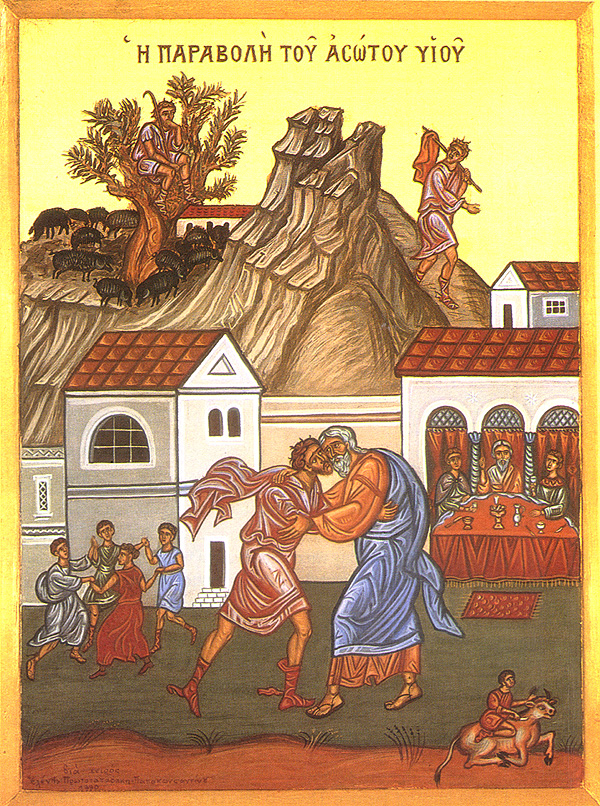
SUNDAY OF THE PRODIGAL SON
LITURGY:
Epistle: 1 Corinthians 6:12-20
Gospel: Luke 15:11-32
SUNDAY OF THE PRODIGAL SON – Feb 16, 2025
“Your brother was dead and is alive again, and was lost and is found.”
***
1 Corinthians 6:12-20 (Epistle)
All things are lawful for me, but all things are not helpful. All things are lawful for me, but I will not be brought under the power of any. Foods for the stomach and the stomach for foods, but God will destroy both it and them. Now the body is not for sexual immorality but for the Lord, and the Lord for the body. And God both raised up the Lord and will also raise us up by His power. Do you not know that your bodies are members of Christ? Shall I then take the members of Christ and make them members of a harlot? Certainly not! Or do you not know that he who is joined to a harlot is one body with her? For “the two,” He says, “shall become one flesh.” But he who is joined to the Lord is one spirit with Him. Flee sexual immorality. Every sin that a man does is outside the body, but he who commits sexual immorality sins against his own body. Or do you not know that your body is the temple of the Holy Spirit who is in you, whom you have from God, and you are not your own? For you were bought at a price; therefore glorify God in your body and in your spirit, which are God’s.
Luke 15:11-32 (Gospel)
“Then He said: “A certain man had two sons. And the younger of them said to his father, ‘Father, give me the portion of goods that falls to me.’ So he divided to them his livelihood. And not many days after, the younger son gathered all together, journeyed to a far country, and there wasted his possessions with prodigal living. But when he had spent all, there arose a severe famine in that land, and he began to be in want. Then he went and joined himself to a citizen of that country, and he sent him into his fields to feed swine. And he would gladly have filled his stomach with the pods that the swine ate, and no one gave him anything. But when he came to himself, he said, ‘How many of my father’s hired servants have bread enough and to spare, and I perish with hunger! I will arise and go to my father, and will say to him, “Father, I have sinned against heaven and before you, and I am no longer worthy to be called your son. Make me like one of your hired servants.”’ And he arose and came to his father. But when he was still a great way off, his father saw him and had compassion, and ran and fell on his neck and kissed him. And the son said to him, ‘Father, I have sinned against heaven and in your sight, and am no longer worthy to be called your son.’ But the father said to his servants, ‘Bring out the best robe and put it on him, and put a ring on his hand and sandals on his feet. And bring the fatted calf here and kill it, and let us eat and be merry; for this my son was dead and is alive again; he was lost and is found.’ And they began to be merry. Now his older son was in the field. And as he came and drew near to the house, he heard music and dancing. So he called one of the servants and asked what these things meant. And he said to him, ‘Your brother has come, and because he has received him safe and sound, your father has killed the fatted calf.’ But he was angry and would not go in. Therefore his father came out and pleaded with him. So he answered and said to his father, ‘Lo, these many years I have been serving you; I never transgressed your commandment at any time; and yet you never gave me a young goat, that I might make merry with my friends. But as soon as this son of yours came, who has devoured your livelihood with harlots, you killed the fatted calf for him.’ And he said to him, ‘Son, you are always with me, and all that I have is yours. It was right that we should make merry and be glad, for your brother was dead and is alive again, and was lost and is found.”
***
Homily for the Sunday of the Prodigal Son (16 February 2025)
Fr. Peter Choi
In the name of the Father, Son, and Holy Spirit. Amen. Glory be to Jesus Christ!
Today is the Sunday of the Prodigal Son. As we approach Great Lent, the Church continues to provide us with examples of desire, repentance, mercy, and forgiveness. Two Sundays ago, we saw the desire of Zacchaeus. Last Sunday, we saw the contrast between repentance in humility leading to righteousness and good works in pride leading to self-righteousness. And today, in the usual Christian fashion of saying important things three times, we are told another parable to drive home the message for the third time.
Today’s reading from the Gospel according to St. Luke (15.11-32) takes place while Jesus was on his way to Jerusalem and all the tax collectors and sinners were coming near to listen to him. And the Pharisees and the scribes were grumbling and saying, “This fellow welcomes sinners and eats with them. (Lk 15.1-2)
And in response, Jesus told three stories regarding the lost and found. Today’s story was the last of the three.
One of the things with Jesus’ parables is that He often takes a story that would be familiar to His Jewish listeners and He changes it so that the ending comes out differently. And this is what He did in today’s parable. He starts with the statement, “There was a man who had two sons” (Lk 15.11). Any Jew who heard this would think of the stories in the Old Testament, where the elder son would lose his blessing. They would think about Cain and Abel; Ishmael and Isaac; Esau who lost his birthright and blessing to the younger Jacob, and Joseph’s firstborn Manasseh losing his grandfather’s blessing to his younger brother Ephraim. You can imagine the audience nodding their heads, thinking they knew where this story was going. They’re going to identify with the younger son.
The younger son asked his father to give him his share of the inheritance before his father had died. And the father agrees to do this instead of rebuking his son. Traditionally, this action has been interpreted as an insult to the father as it implied that the son wanted the father to be dead. But Jewish scholars point out that no Jewish parent would agree to do this if they felt insulted and dishonoured. They’d give their child a piece of their mind. The father might have been seen as being a bit foolish to go along with the request because he probably loved his younger son too much.
The younger son then goes on a journey to a distant country. Again, the readers would have nodded in expectation because the typology would have been familiar to them. The son is going to end up at a well, he would meet a woman, one of the two would water the livestock, and the two would get married, and after a series of adventures the son would return home with a family and wealth, the signs of God’s blessing, and the son would probably give the father far more than he received. That’s the story of Jacob, otherwise known as Israel. (The meeting at the well is also the story of Isaac by proxy and the story of Moses.) Everyone would have been rooting for the younger son.
But to the surprise of Jesus’ listeners, the story went against type. The younger son didn’t act righteously. He didn’t fall in love and get married. He didn’t become wealthy. He spent his entire inheritance in dissolute living (Lk 15.13). He ended up hiring himself out to a Gentile to feed pigs in a foreign land. No Jew would have raised pigs, since pork wasn’t kosher. Jesus’ listeners would have been a bit confused and uncomfortable. The person whom they rooted for didn’t turn out to be a “good” person. In fact, the younger son sounded a lot like a “sinner.”
Even the younger son’s decision to return home wasn’t as reassuring as we might think. Remember, we are reading this story in the light of the message of the resurrection of Jesus Christ and with the benefit of the New Testament and neither of these existed at the time of the parable. The son’s statement, “Father, I have sinned against heaven and before you” (Lk 15. 18b) sounded a lot like the Pharaoh’s statement to Moses, “This time (after the seventh plague) I have sinned; the Lord is in the right, and I and my people are in the wrong” (Ex 9.27). We know that Pharaoh’s admission wasn’t sincere. An interpretation, if one had grown up reading the Old Testament, was that the son wasn’t sincere but was hoping to get a job back home without the responsibilities of a son.
The story gets more interesting. The younger son returned home and before he could completely recite the part of his prepared statement that asked his father, “treat me as one of your hired servant,” the father had already instructed his household to prepare a celebration and to welcome his lost son home as a son. Regardless of the sincerity of the repentance of the son, the father had restored him as a member of the family. This goes against the typical typology for a story about two brothers. None of the listeners would have expected this.
What about the elder son? Elder sons seem to get the short end of the stick in the Old Testament but this was often due to something related (fairly or unfairly) to their character. Cain murdered his brother. Ishmael was driven away not because of what he did but because he wasn’t the biological son of Sarah. Esau didn’t care about his birthright or his ethnicity – he was ruled by his own appetites and gave up his birthright for red stew and he married Canaanite women. But in Jesus’ story, the listeners heard that the elder son had been the responsible one. He had served his father for many years and had never disobeyed his command. This would have sounded like righteousness to the Jews. And let’s be fair, this sounds like righteousness to us Christians too. After all, how many saints are described in the same way?
The elder son was angry and he complained about the different treatment that he and his younger brother received. He didn’t mince his words. “[T]his son of yours […] has devoured your property with prostitutes” (Lk 15.30). When his younger brother left, he had stopped thinking about him as a family member. He assumed the worst and that came to be true about the younger brother. His father was foolish to have given away half his property and he was foolish now to restore him to the family. I think a lot of listeners would have related to the elder son’s reactions.
What did the father do? The father reassured his elder son, “Son, you are always with me, and all that is mine is yours.” (Lk 15.31) And he asked his elder son to be merciful and rejoice in the return of the younger son.
Now imagine the reactions of the listeners. Jesus was speaking to tax collectors, sinners, Pharisees, and scribes (members of the Sadducees). Those who had tried to strictly follow the Mosaic law, the Torah, in hope of the fulfillment of God’s promise of deliverance would probably have identified very strongly with the elder son by the end of the story. The Pharisees would have been amongst this group. Those who followed the Torah less strictly, or maybe broke the Mosaic law, would see a bit of themselves in the younger son. Both identities would be uncomfortable but hope was extended to every listener regardless of which son they identified with.
For the sinners, Jesus is telling a story that offers the hope of forgiveness and restoration of communion. This is offered regardless of the level of sincerity of the repentance. The younger son desired food and he acted upon this by returning home. He acknowledged his need and that was enough. We often think of the younger son in this parable as being humble but there isn’t anything to prove this. In most Jewish stories, humility and repentance would have been shown with tears or prostration or wearing of sackcloth or putting of ashes on one’s head. The younger son had changed his mind and went home but hadn’t done anything else yet. There was no time. The father acted before we could actually assess the sincerity of the younger son. From the perspective of the father, how often do we wait before we welcome someone back? And from the perspective of the younger son, how sincere is our repentance? If we feel that we are sincerely trying to repent, how often do we fall into the trap of thinking that we cannot be forgiven because our repentance isn’t sincere enough? The truth is that we are never “sincere” enough yet God forgives, but we are not to expect the grace of God in the absence of turning back towards God. If we are hungry, we have to come home to enjoy the banquet.
In this story, Jesus is also saying something to those who are striving to be righteous. As I mentioned at the beginning of this homily, this parable is the third of three parables about the lost and found. The first was the parable of the lost sheep and the second was the parable of the lost coin. In both of those parables, Jesus relates the finding of the lost to the repentance of one sinner. In both of those parables, the owner searches for the lost.
In today’s parable of the Prodigal Son, we usually think of the younger son as the one who was lost because the father stated that “he was lost and has been found” (Lk 15.32b). But look at the parable closely. Who does the father seek out? The father never searched for the younger son. He waited for him but he did not go to the distant country. The father sought out his elder son when the elder son refused to join the banquet. His elder son might have been a bit self-righteous but the father ignores this. He reminds his elder son that he’s already part of the family and has everything. He appeals to his elder son to act mercifully. For those whose righteousness leads to anger at those who are forgiven without punishment and refuses to have anything to do “sinners,” God asks for them to repent by having mercy and by rejoicing on His behalf. The elder son was lost too but he didn’t know that. He was sought after and, if he returned home, the rejoicing would be great.
By coming to church today, we have returned home. As we proceed to the liturgy of the faithful, let us remember that regardless whether we identify as the prodigal son or the elder son, we have been found and God restored us to communion with Himself and one another. If you are burdened with a sin that you haven’t confessed yet, now is the time to ask the Lord to have mercy on you and know that he will be merciful. If you have something against your brother or your sister, now is the time to have mercy and forgive. Let us do this so we may partake of His Body and His Blood in anticipation of our final resurrection and in the hope of entry into the kingdom of the Father, Son, and Holy Spirit. Amen.erve their faith when they were not at the Temple.
 Holy Theophany Mission