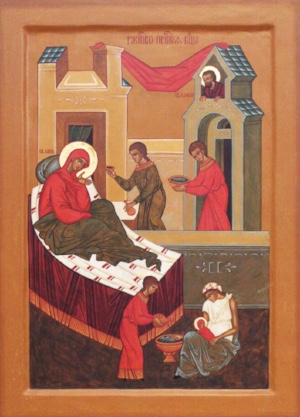

The Nativity of the Theotokos, Sunday before Elevation.
LITURGY:
Epistles: Galatians 6:11-18
1 Corinthians 9:2-12
Philippians 2:5-11
Gospels: John 3:13-17
Matthew 18:23-35
Luke 10:38-42; 11:27-28
***
Homily on the 11th Sunday after Pentecost / Nativity of the Theotokos / Sunday before the Exaltation of the Cross
Fr. Peter Choi
In the name of the Father, Son, and Holy Spirit. Amen. Glory be to Jesus Christ!
Today is an interesting Sunday. It is the 11th Sunday after Pentecost and the Nativity of the Theotokos, the first great feast in the church year. And it is also the Sunday before the Exaltation of the Cross. As a result of this, we have three gospel readings – one each from Matthew, Luke, and John – for our reflection.[1] One of the themes in all three readings is forgiveness in contrast to condemnation.
The Sunday Gospel (Mt 18.23-35) for today is the parable of the unforgiving servant. Jesus described a servant who had a debt that was so huge, ten thousand talents – more than 15 years’ worth of wages – that in modern times would have resulted in bankruptcy. The servant knew he was indebted and deserved punishment but begged for mercy. And instead of him and his family being sold into slavery, his master forgave his debt. And this servant then turned around and threw a fellow servant into jail for owing him a hundred denarii – several hundred dollars in modern currency. He condemned his fellow servant.
The word “condemn” comes from the Latin condamnare, which means “to inflict (severe) loss on.” This was what the unforgiving servant did. Because imprisonment wasn’t just about being locked up. In the judicial system of the time, torture was part of the jailor’s job in obtaining the “truth” during the judicial examination. The word that is sometimes translated as “jailor” in this parable (Mt 18.34) is literally “one who tortures or torments.” So the unforgiving servant had his fellow servant tortured for a small debt. And when the master heard this, he had the unforgiving servant handed over to the same torturers, not for his debt, but for his lack of forgiveness of his neighbour.
The point I want to make is this: forgiveness is the flip side of repentance. From a divine perspective, we are morally bankrupt. When we stand before the gospel and the cross during the sacrament of Holy Confession, we are to acknowledge our sins – not in defiance – but as ones who have nothing to offer and can only ask for forgiveness. That acknowledgement of our sins, our trespasses, is the confession; the decision to (re)turn to God is the repentance. In return, we are asked to imitate our Master and forgive others who have trespassed against us.
We are fortunate that we have a loving God. When we condemn our neighbours and fail to forgive them, He does not rescind His forgiveness. But when we fail to forgive our neighbours, we throw ourselves into the hands of torturers and tormentors. We allow our passions – resentment, anger, self-pity, etc. – to torment us and imprison us. Our desire that our trespassers be punished results in our own self-inflicted torment.
Now there are times when we, as human beings, would agree that someone has trespassed against us and we are asked to forgive. But there are other times, when the trespass is really about our neighbour failing to do what we want. The reading from the Gospel according to St. Luke (10.38-42; 11.27-28) highlights this. This is the gospel reading for all the feasts of the Theotokos and it is the story of Jesus’ visit at the home of Mary and Martha, the sisters of Lazarus. Mary sat at Jesus’ feet and listened to what Jesus had to say. She gave Him her full attention. Martha was listening too but she was distracted with much serving. Martha expressed her love for Jesus by service. And in her eyes, Mary was not serving the Lord and Martha was unhappy about this. She wanted Jesus to do something about this.
Does this sound familiar to any of us? Are there not times when we feel like Martha? We think that our neighbour has trespassed against God by not doing what we would have done if we were in our neighbour’s position. But what we’re really feeling is a sense of injustice, of being trespassed upon, because our neighbour isn’t behaving in the way we feel is appropriate for Christians. Like Martha, we want God to agree with us, to condemn our neighbour, and to tell our neighbour to change or “repent.” In those situations, we are kind of like the unforgiving servant. But instead of owing us something directly, we think our neighbour owes our Master something and indirectly owes us something because our neighbour – a fellow servant – is not doing their share of the Master’s work or making us servants look bad. So we respond like the unforgiving servant and judge.
But notice Jesus’ response to Martha. He doesn’t disagree with Martha’s statement that Mary isn’t serving Him. Instead, He contrasts the responses of the two sisters. Both Martha and Mary had good reasons for being worried and troubled. In the Gospel according to St. John, Jesus’ visit to Martha’s house took place after Jesus raised her brother Lazarus from the dead. Martha expressed her love for Jesus by serving and hospitality and this wasn’t “bad.” There are times when we are asked to serve. Mary expressed her love for Jesus by being still in His presence, by resting closely and being comforted by Him, not distracted by the goings-on in the world around her. Later on, Mary would anoint Jesus’ feet with a pound of pure nard after supper. She was worshipping Him. And we are also asked to worship.
The difference in the two sisters’ responses to Jesus were in their focus. Martha, while loving Jesus in service, focused her attention on her sister and, in doing so, felt imposed upon by her sister. Mary focused her attention solely on Jesus. So, when we think that our neighbour has trespassed against God by not doing what we would have done if we were in our neighbour’s position, we need to take our eyes off our neighbour and focus them on God. If God is not offended, why should we be offended?
Why are we offended? Why is it easier for me to judge and condemn than to forgive? It is easier to judge and condemn when we are not focused on what God has done for us and when we are not listening to God. This happens when we behave like the unforgiving servant and forget how God has forgiven us and focus on our neighbours’ debts to us. This happens when we focus on how others relate to God instead of how we relate to God. This happens when we do not imitate Jesus.
The Gospel reading for the Sunday before the Exaltation of the Cross (Jn 3.13-17) tells us how God forgives. God forgives by loving us to the extent that the Son of God became man, suffered the consequence of sin in death, and then destroyed death, releasing us from the bondage of sin and death, and resurrected.
For God so loved the world that He gave His only begotten Son, that whoever believes in Him should not perish but have everlasting life. For God did not send His Son into the world to condemn the world but that the world through Him might be saved. (Jn 3.16-17)
We can truly forgive if we love God and love our neighbour as Christ loves us. We can truly forgive if our eyes are looking up at the Son of Man, who was lifted up on the Cross. We can truly forgive if we put to death and bury whatever makes us break communion. We can truly forgive if we desire the salvation of one another to the extent that we would rather die for our neighbour than to condemn our neighbour.
By the grace of the Holy Spirit, this is what we are to do. At the start of Great Lent, during Forgiveness Sunday Vespers, we say to one another, “God forgives and I forgive.” Great Lent is still a long time from now in the church year. Yet even at the start of the church year, we start with forgiveness. May we forgive one another as God forgives us so that we may enter into the kingdom of the Father, Son, and Holy Spirit. Amen.
[1] There are three Gospel readings for today’s Divine Liturgy service but the rubrics instruct us to only read a maximum of two Gospel readings when we serve Liturgy. The Gospel reading for the day (Sunday – Mt 18.23-35) is always read. As the feast of the Exaltation of the Cross takes precedence over the Nativity of the Theotokos, the reading for the Gospel for the Sunday before the Exaltation of the Cross (Jn 3.13-17) is the other gospel read today. The reading for the Nativity of the Theotokos (Lk 10.38-42; 11.27-28) will be read during the Liturgy for the Leavetaking of the Nativity of the Theotokos.
 Holy Theophany Mission